
The cardiac electrophysiology team at the Division of Cardiology and Department of Internal Medicine at the American University of Beirut Medical Center (AUBMC) performed on Thursday, August 9, 2018 the first leadless pacemaker implantation in Lebanon (Figure 1). The procedure which took around 15-20 minutes was well-tolerated by the patient who was discharged within 24 hours.
This world’s smallest wireless pacemaker is an FDA-approved one-piece, pill-sized device that is more than 90 percent smaller than traditional pacemaker designs which date back more than 50 years. Demonstrating exceptionally high safety and efficacy, the state-of-the-art technology has been increasingly used in the US and Europe and has been newly introduced in Lebanon and very few other countries in the region.
The procedure was performed by Dr. Marwan Refaat and Dr. Bernard Harbieh, cardiologists/cardiac electrophysiologists at AUBMC and assisted by Dr. Mikhael El-Chami, cardiologist/cardiac electrophysiologist at Emory University Medical Center.
The procedure is useful in some patients with bradycardia or slow or irregular heart rhythms. Bradycardia is a condition characterized by a slow or irregular heart rhythm, usually fewer than 60 beats per minute, causing in some patients episodes of dizziness, fatigue, shortness of breath or fainting spells during normal activity or exercise. Traditional pacemakers that help patients with bradycardias rely on long wires that carry electrical pulses into the heart from a separate unit implanted in the patient’s chest. These systems can present a source of infection, and the leads can become vulnerable to damage or fractures over time.
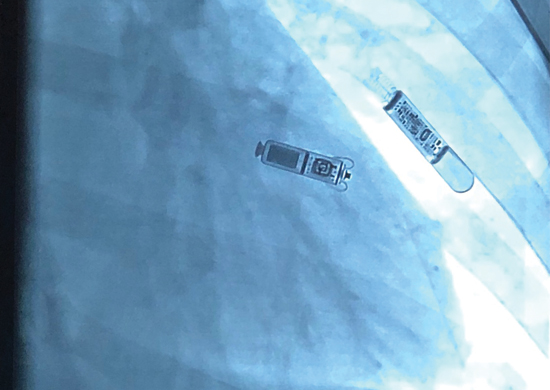
Dr. Refaat said, “Unlike traditional pacemakers, this device does not require cardiac wires, or leads, or a surgical pocket under the skin.” He added,“ Thanks to its small pill size and light weight which is one third the weight of a 500 Lebanese pound’s coin, we could deliver it through a catheter from the leg and implant it directly into the heart. Dr. Maurice Khoury, Chairman of the cardiac electrophysiology section at AUBMC said, “The device creates no lump under the skin on the chest and reduces complications associated with leads- all while being cosmetically invisible.”
Dr. Bernard Harbieh said, “This revolutionary technology will greatly improve patient outcomes and satisfaction. We are very fortunate to be the first Medical Center in Lebanon to offer the smallest pacemaker in the world to our patients here at the American University of Beirut Medical Center.”Established in 1996 by Dr. Maurice Khoury, the cardiac electrophysiology section at AUBMC has always been leading the way in performing catheter ablation and implementing new device therapies for the treatment of patients with heart failure and heart rhythm disease in Lebanon and the region.This procedure is another proof of AUBMC being on track in achieving its 2020 Vision and maintaining its role as the leading Medical Center in Lebanon and the region in terms of using techniques and skills that help save the lives of people. procedure is another proof of AUBMC being on track in achieving its 2020 Vision and maintaining its role as the leading Medical Center in Lebanon and the region in terms of using techniques and skills that help save the lives of people.